In the cultural and artistic life of Medicean Florence the performing arts played a substantial role and found in the court (and in the academies) the propulsion center; they were, in fact, an instrument of the grand-ducal government, able, at the same time to attract consensus and distract from the lack of participation in power on the internal front, and strengthen the family's prestige on the European front. Funeral ceremonies and wedding parties became instruments of self-celebration and promotion, but also opportunities for theatrical experimentation.
The precious collection of Count Girolamo dei Bardi, who came to the library through the Pious Institute that he founded, and consisting of 13,600 ancient editions that span almost every field of knowledge, offers many testimonies of Florentine life between the 16th and 18th centuries.
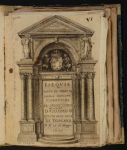
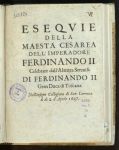
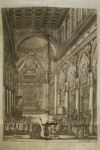
From the miscellaneous volumes we have picked some exemplary items that illustrate the grandness of the representation of death in the Medici family: from the funeral effigy of Cosimo II (1621) celebrated in Venice by the Florentine community, to those celebrated in S. Lorenzo, for the emperor Ferdinand II (1637) and for Philip IV, set up in 1665 by Ferdinando Tacca.
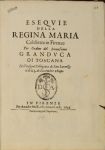
In the funeral of Maria de' Medici, Queen of France in exile (1642), what most strikes the viewer is the contrast between the subdued tone of the funeral ceremony and the sumptuous one of the wedding with Henry IV of France (1600), which saw the representation of Eurydice by Ottavio Rinuccini.
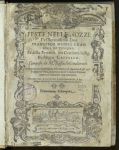
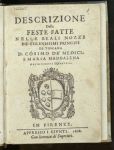
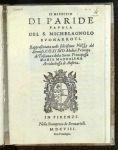
We also present the description of the wedding receptions of Francesco I de' Medici with Bianca Cappello (1579), when for the first time the Sbarra was organized: a short armored carousel, in the courtyard of Palazzo Pitti, and that of Cosimo II's with Maria Maddalena of Austria, (1608), together with the Judgment of Paris that was represented on the occasion, by Michelangelo Buonarroti the Younger, who served as a poet and corago.