When the Institute of Higher Studies was established, Florence already had a tradition of studying languages and civilizations that were overlooking the eastern Mediterranean. The knowledge of Hebrew was appreciated since Humanism and favored by Cosimo III; materials coming from Ancient Egypt were present in the Medici and Leopoldine collections. In 1584, Cardinal Ferdinando de' Medici created in Rome the Oriental Medicean Printery, then transferred to Florence and used by the Institute for its publications.
Right from the beginning, the Philosophy and Philology Section included the chair of Arabic, held by Michele Amari, and of Sanskrit, entrusted to Angelo De Gubernatis since 1863. There followed by the chair of Languages of the Far East, the first in Italy, held by Severini. In the 1870s and 1880s numerous, often unprecedented teachings were activated, including Hebrew, comparative Semitic Literature and Assyriology, held by Castelli, Lasinio, Scerbo, and Finzi, whose personal libraries are now part of the Humanities catalogue. The Fourth International Congress of Orientalists established the primacy in Italy and the international prestige of the Institute; journals flourished and the Oriental Academy was founded, then the Asian Society, of which the library holds the former collection, while precious volumes and manuscripts were acquired from foreign scholars, such as Bernhard von Dorn.
Another field in which the Section excelled was papyrology, thanks to Girolamo Vitelli, a distinguished philologist and professor of Greek Literature at the Institute, who dedicated himself to the study and publication of papyri. He formed an important Florentine school (Breccia, Norsa, Pistelli, Bartoletti) and gave life to the "Italian Society for the Search of Latin and Greek Papyri in Egypt", which organized various excavation campaigns. In 1928 the Papyrological Institute incorporated his legacy, which further increased its international prestige.
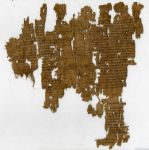
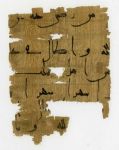
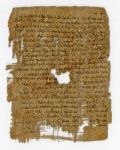
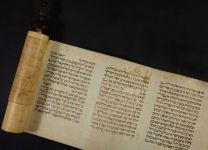
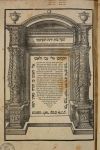
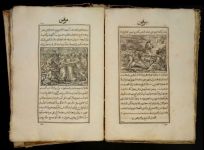
As evidence of this fruitful tradition of studies, five manuscripts are displayed here: four precious papyri, including a figured one and a fragment of Euphorion, in Greek, Arabic and, very rare, Syriac, dated between the 2nd and 10th centuries AD, discovered in the excavation campaigns of the Papyrological Institute, and a Hebrew parchment scroll from the end of the seventeenth century belonging to the Library collections. In addition to these there are two precious 16th century printed texts: the Magna Biblia Rabbinica and the first edition of the New Testament in Arabic.